
How Solano County Residents Are Found
Solano County is not one city. The resident trail runs through Benicia, Dixon, Fairfield, Rio Vista, Suisun City, Vacaville, Vallejo, and the unincorporated stretches between them. The clue in hand picks the starting office. An address leads to a parcel first. A name can surface in a court party search. It might also appear in a business filing, a license, an obituary, or a historical city directory. A family question may call for a vital certificate or probate file instead of an owner record. The Solano County residents directory works best when each source answers one narrow fact.
Ownership and occupancy are different things. A deed names the parties to a recorded event, an assessment may carry a mailing address, and a voter tool confirms one person's own registration. None of them lists everyone at an address. Start with the least sensitive source. Keep spellings and date ranges exact, then anchor any merge of two records with a second independent fact.
- Resolve an address in the Solano Property & Assessment Search or a ReGIS parcel application.
- Use California My Voter Status only for the person's own identity verification.
- Search the Solano Official Records Index by party name, date, and document type.
- For an older household, consult library directories, newspapers, census schedules, and local-history collections.
- Ask the custodian for an existing, identifiable record series when the online trail stops.
Offices Behind the Solano County Residents Directory
Fairfield is the main records hub. Even so, custody across Solano County is split. The Assessor and Recorder connect parcels, maps, deeds, liens, and public vital records. The Treasurer-Tax Collector-County Clerk is separate. That office keeps fictitious business names, marriage licensing, confidential marriage copies, and tax functions. Superior Court holds probate, civil, family, and traffic files in Fairfield and Vallejo, while voter, license, business, and privacy tools come from the Secretary of State and other state agencies. No single index is a countywide people roll.
Solano County Assessor/Recorder
675 Texas Street, Suite 2700
Fairfield, CA 94533-6338
707-784-6294
Solano County Clerk
Treasurer-Tax Collector-County Clerk
Fairfield, California
707-784-7510
Solano Superior Court
Fairfield and Vallejo facilities
Solano County, California
707-207-7340
The California Public Records Act, Government Code §§7920.000 et seq., is the fallback when a specific record exists and can be identified. The law creates no new lists. Nor must an office answer a research question. Ask instead for a record series, date span, address, parcel, case number, or filing name the custodian can actually locate.
Solano County Residents Directory Property Search
A property search starts with the land. The county Property & Assessment Search accepts a parcel number or street address. ReGIS applications help locate the polygon and its jurisdiction. A parcel record can supply an APN, situs address, legal or subdivision context, assessed land and improvement values, and tax-rate-area geography. The owner's mailing address is a separate field. That field may point outside the parcel, and it never proves who actually lives there.
ReGIS works as a regional map hub. Its coverage spans Solano County, all seven cities, LAFCO, districts, and Travis Air Force Base. Exact controls vary by application. Search the address or APN, zoom to the parcel, select the polygon, open its attributes, and switch on only the layers the question needs.
Open the Solano ReGIS application gallery first. The viewer is useful for orientation. It is not a survey, and it is not a certified title record.
| Search field or control | Type | How it helps |
|---|---|---|
| Address | Text or geocoder | Finds a situs when an APN is not known |
| APN | Text | Uses the parcel identifier as the more stable key |
| Map navigation | Zoom and pan | Reaches a street segment or rural parcel |
| Parcel select | Click or polygon tool | Opens attributes for one parcel |
| Layers and legend | Map controls | Separates city, county, district, zoning, or flood context where enabled |
The ReGIS public applications page anchors county address lookups.
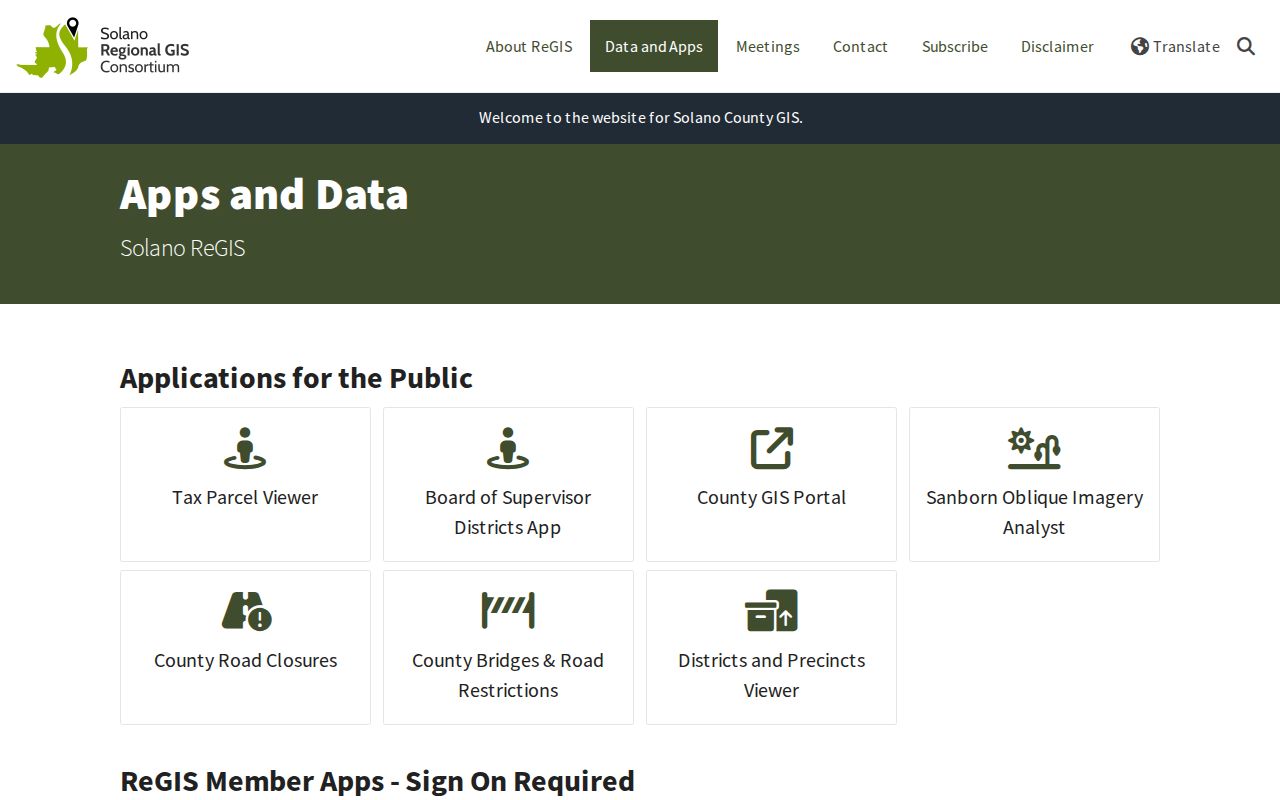
The gallery makes record geography visible across Solano County. It shows where a postal community, a city line, a district, and a parcel jurisdiction fail to match.
Solano County Deed Index and Address Trail
The Recorder's Official Records Index is a party index. Street addresses are not stored as searchable Official Records data, according to the office FAQ. So resolve the address first. Assessor or GIS material can turn it into an APN, a current owner, and a legal description before the recorder search begins. Then search grantor, grantee, date, and document type. A grantor transfers an interest; a grantee receives it. Deeds, deeds of trust, reconveyances, liens, releases, easements, and maps build a dated land trail.
Online and public-computer searching reaches 1955 to the present. Books from 1954 and earlier need the office. Solano County's recorded history begins in 1850, though the search page does not state the earliest web-index date. Copies go out by mail or in person. The published charge is $9 for the first page, $1 for each added page, and $5 for certification.
The Solano Official Records Index shows the narrow fields a result can support.
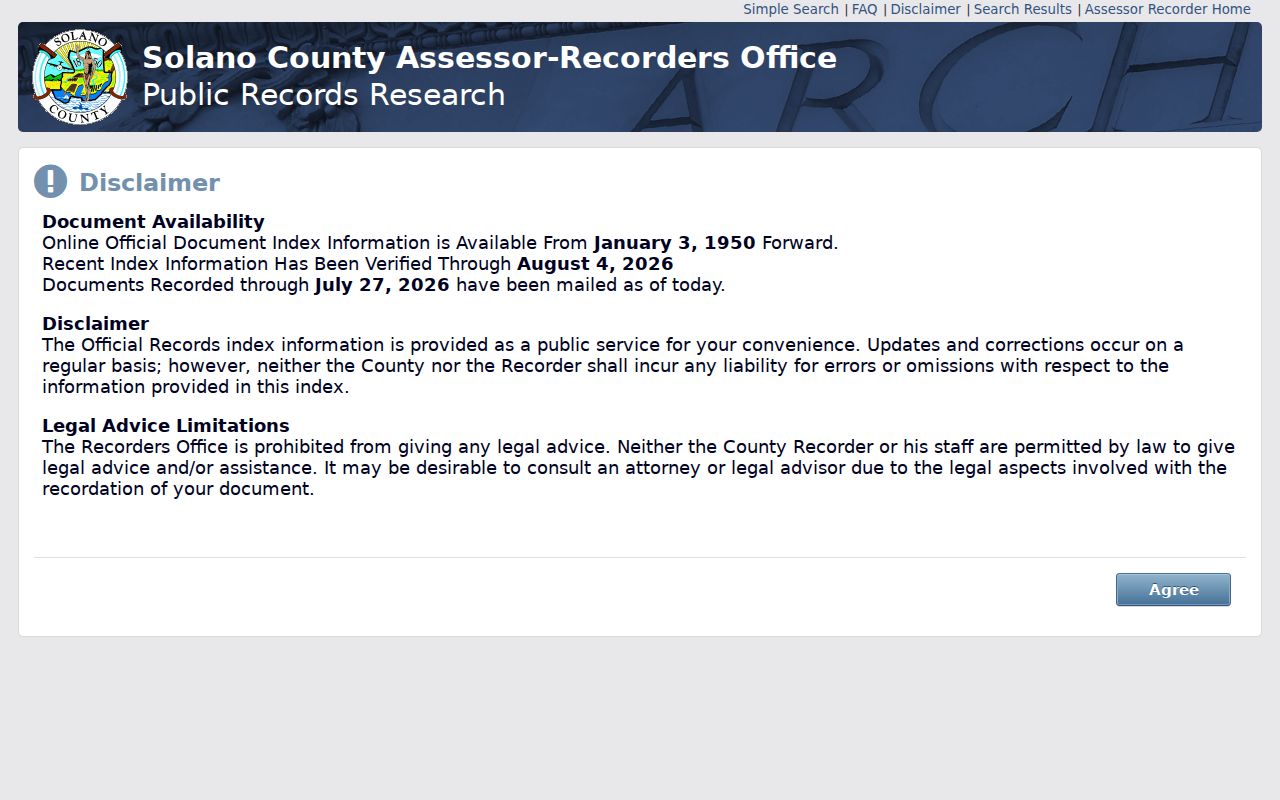
A result establishes an indexed party, a document type, a recording date, and a document identifier. It proves nothing about where someone lived. Situs residence on a given day needs other proof.
- Parcel
- A mapped unit of land identified by the assessor's parcel number.
- Situs address
- The physical location of the parcel, distinct from a mailing destination.
- Index
- A finding aid with selected fields, not the complete recorded instrument.
- Legal description
- The subdivision, lot, block, or other land description that helps bridge street-number changes.
Current Solano County Residents Directory
A Solano County residents directory is never one record. It is several. The property roll ties ownership to a parcel. ReGIS adds geometry and jurisdiction lines. The Recorder indexes the parties to recorded events, My Voter Status confirms a single matched voter, and permit records, where the city or county releases them, name owners, contractors, and applicants. Every source opens through a different channel, and each has its own reason a name may be missing.
| Source | Who It Lists | Keeper | Access |
|---|---|---|---|
| Assessment roll and parcel map | Parcels, owners or mailing fields where disclosed | Assessor | Web map, email, or counter |
| ReGIS parcel and district layers | Geometry, adjacency, jurisdiction, and districts | Regional GIS partners | Free dynamic viewer |
| Official Records Index | Parties to deeds, liens, releases, and maps | Recorder | Free index; copies by request |
| My Voter Status | One matched voter's status and election details | California Secretary of State | Identity verification |
| Permits and code records | Address, work, dates, and responsible parties | City or County Resource Management | Portal or CPRA request |
Match the record to the question and the trail gets easier. A parcel search answers who is tied to land. A court or business filing separates two people who share a name. An old street directory can show a listed household. For confirming one person across several record types, the Solano County resident lookup workflow beats trusting any single directory hit. Treat one result as a clue, not a conclusion.
Solano County Court Records for Residents
The Solano Superior Court Public Portal is a strong name clue. It sits behind a free account gate, and it refreshes daily. Registration wants an email login and a password. Your name, a phone number, and agreement to terms are also required. A case number is the simplest way in. Name searching works too. You can enter last name, first name, company, and a filed-date range. Name fields need at least two characters. Opening a case number reveals the register of actions. That is a docket-style event history for the case. Confidential cases and documents stay hidden. California Rule of Court 2.504(b) makes remote data unofficial unless it is electronically certified. A certified copy has to come from the right clerk division. The Solano Superior Court Public Portal lays out the account and case-search route.
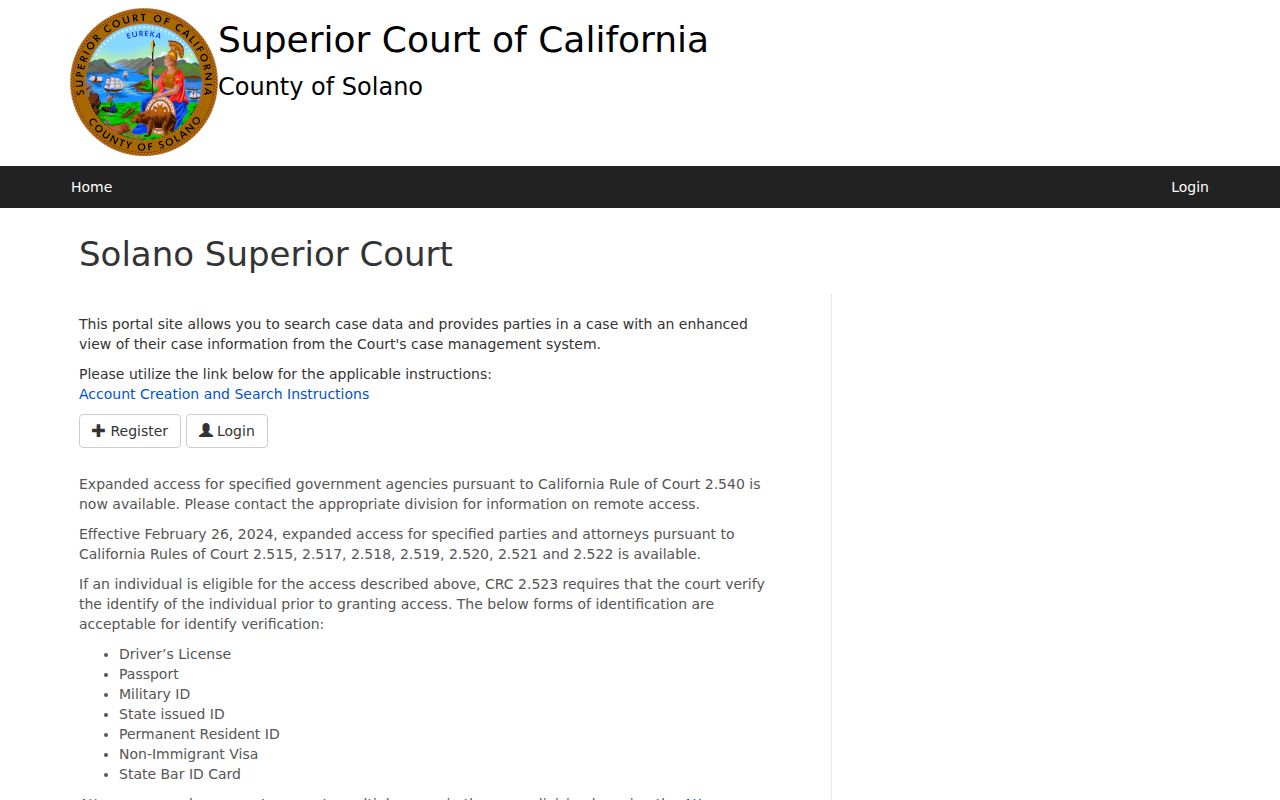
The portal can anchor a party and case timeline. Still, a gap may reflect confidentiality, your access role, or the gap between a remote index and a certified court file.
Solano County Voter Status and Resident Rolls
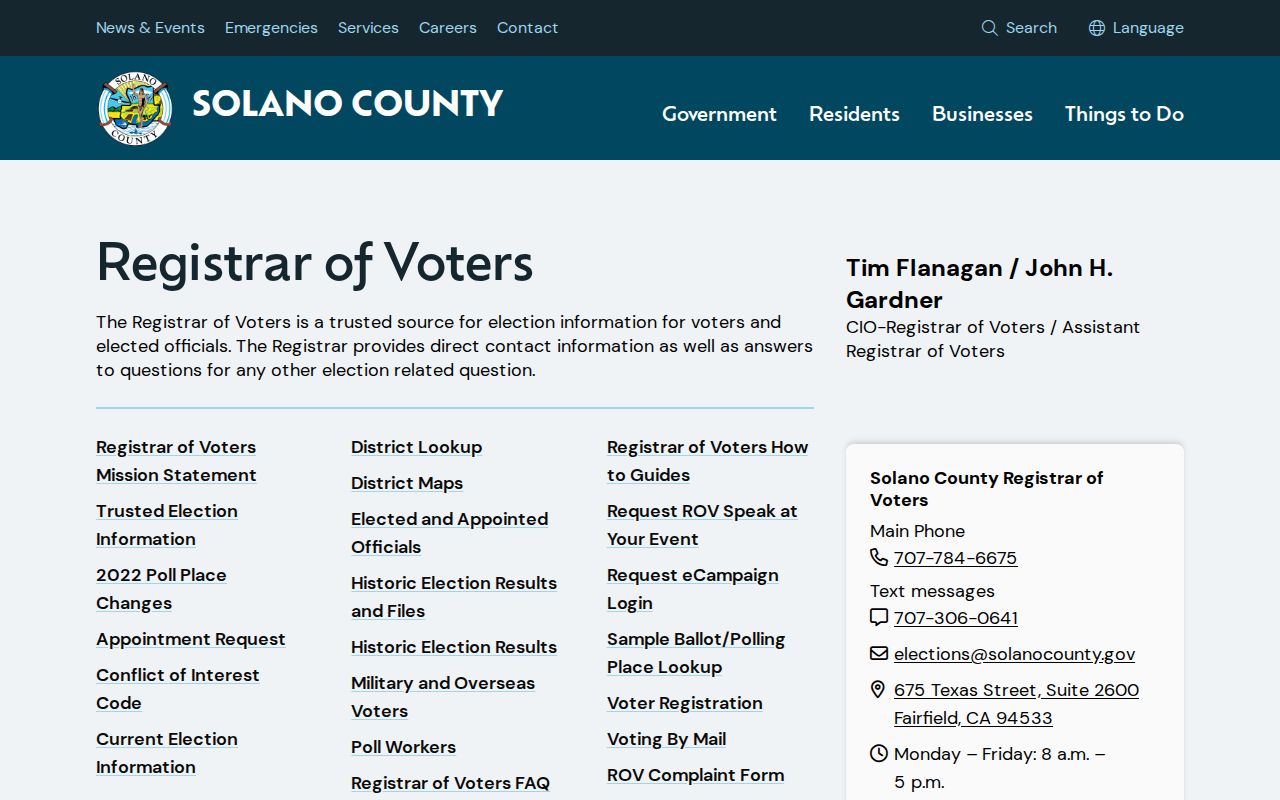
California My Voter Status verifies one voter at a time. It asks for first name, last name, date of birth, and an identity input such as driver's license or California ID details, or the last four digits of a Social Security number where prompted. A matched voter sees registration status, party preference, precinct, polling place, vote-by-mail status, and election material. The tool never shows ballot choices. It is not a public name directory. The voter file works differently. Elections Code §§2180-2194 govern access, and §18109 covers unauthorized use. The Secretary of State application requires applicant identity, permitted purpose, geography, record type, delivery method, and a security plan. A lawful request may involve named voters or an approved file, but a casual ask for everyone on one street is not the same thing. Solano Registrar of Voters staff can be reached at 675 Texas Street, Suite 2600, Fairfield, 707-784-6675, 888-933-VOTE, or elections@solanocounty.com. California My Voter Status shows the identity-matching workflow.
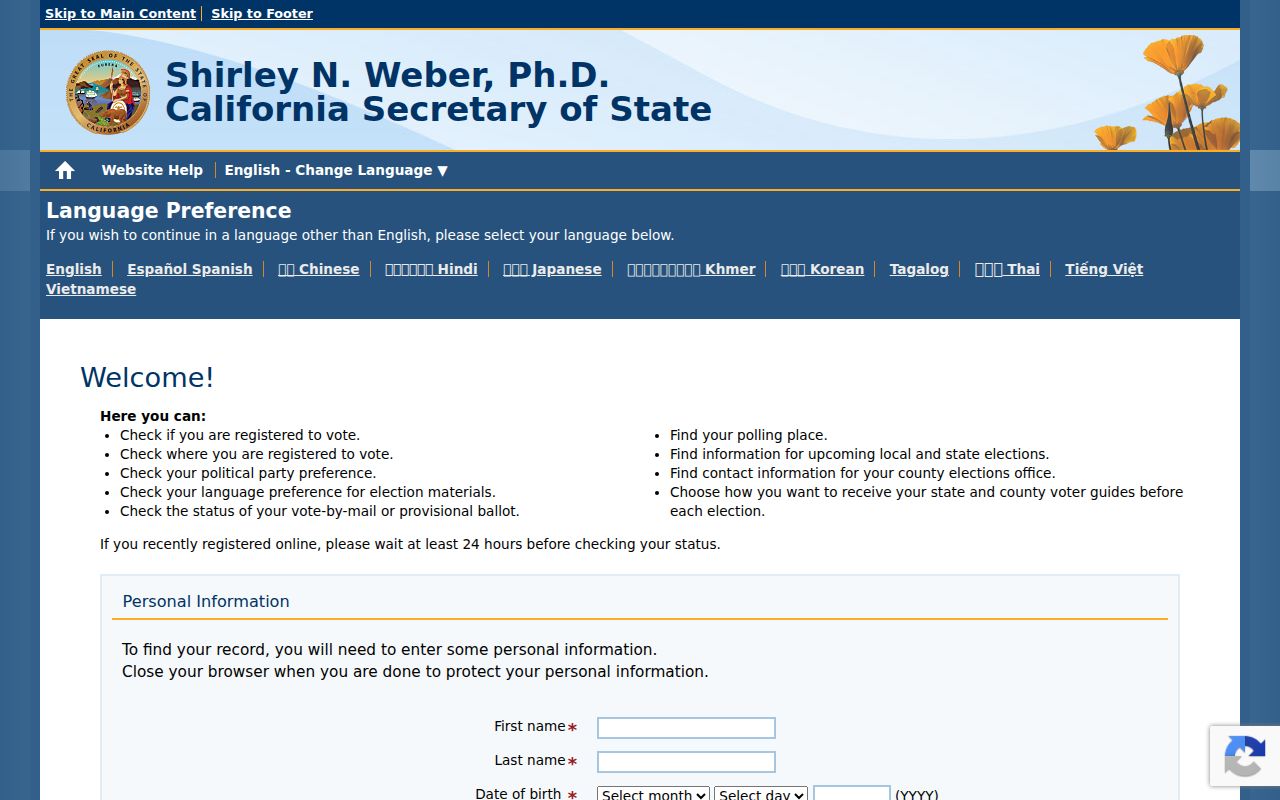
The form exists to keep two things apart. One is a person checking their own record. The other is a restricted voter-file request. Solano Registrar of Voters services provide the local office route for election records and permitted requests.
Historical registration material may sit with county historical holdings or the State Archives. Solano County publishes no complete online year run of those rolls.
Solano County Vital Records and Family Clues
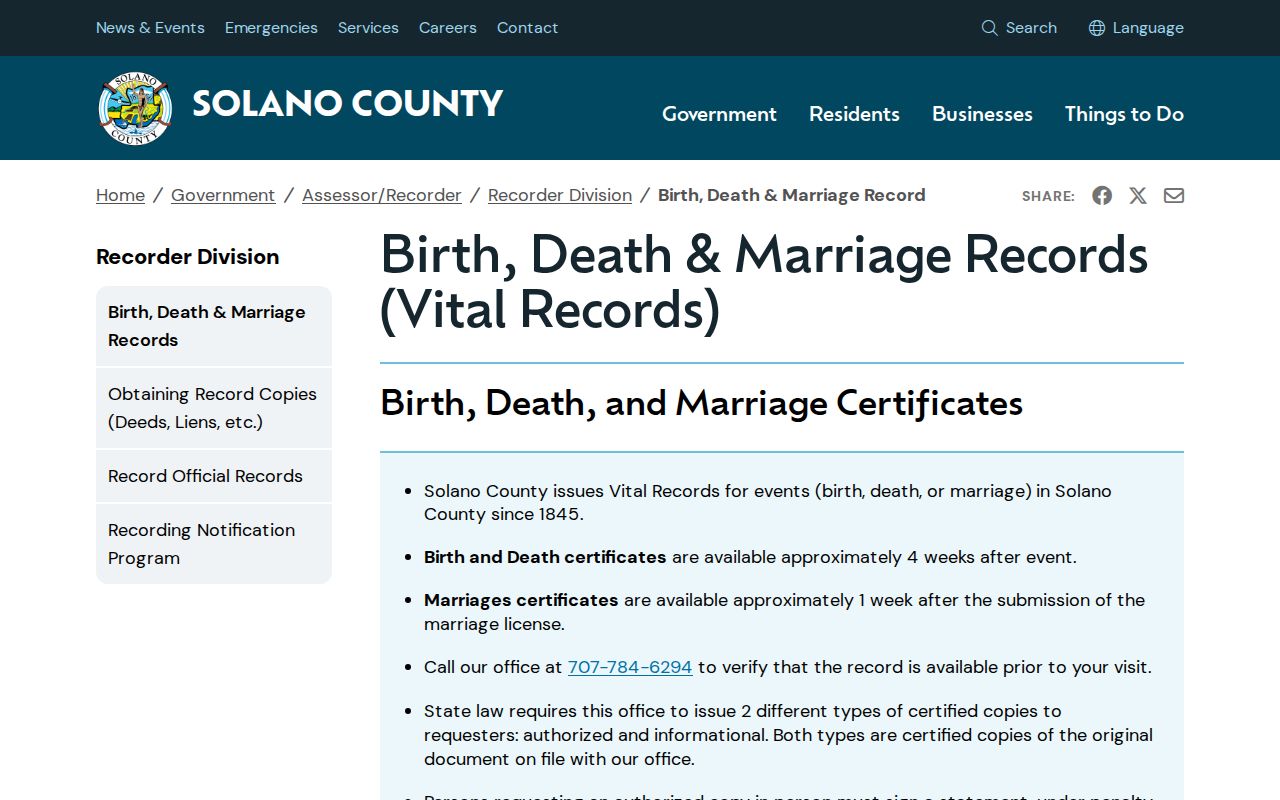
Solano Vital Records sits inside the Assessor/Recorder department. County event certificates there date back to 1845. Public Health handles births at age two and under plus deaths within two years. Older events go to the Recorder. The county issues birth, death, and public-marriage certificates. The County Clerk handles confidential marriages, and the Superior Court holds divorce files. A birth certificate costs $36. A death certificate runs $28, and a public marriage certificate is $21. Turnaround is about four weeks for births and deaths. Marriage records take about one week after license submission. Online orders add a $7 service charge. Authorized copies require eligibility plus a sworn statement. Informational copies are a lawful alternative, marked with a legend that they cannot establish identity. California applies no single closure rule. There is no 100-year bar for births or 50-year bar for deaths. Solano County Vital Records instructions identify the application, counter, mail, and online channels.
Before requesting a certificate, name the event, date, county, relationship, and copy type. A statutory search fee can stay due even when no record turns up.
Solano County Business and License Records
Business and professional indexes can confirm an affiliation. They do not pretend a business address is a home address. Solano's Fictitious Business Name portal searches by FBN name, file number, or filed date. Since January 1, 2024, registrants give a business mailing address rather than a required residential one. A PO box or mail-service address cannot fill the business-address fields. The county portal stays separate from any city record. The California Secretary of State's bizfile searches corporations, LLCs, and limited partnerships. It does so by entity name or number. Results may show status, entity type, registration date, addresses, agent for service, and filing history. The Department of Consumer Affairs license search narrows by board and license type. It also narrows by license number, business or personal name, and city or county. The State Controller's unclaimed-property search offers one more clue, though a claim needs identity proof. California bizfile Online illustrates the entity-search path.
Entity records help with names and affiliations, but a listed agent or mailing address is not always a person's residence, so treat those details as leads rather than proof of where someone lives in Solano County.
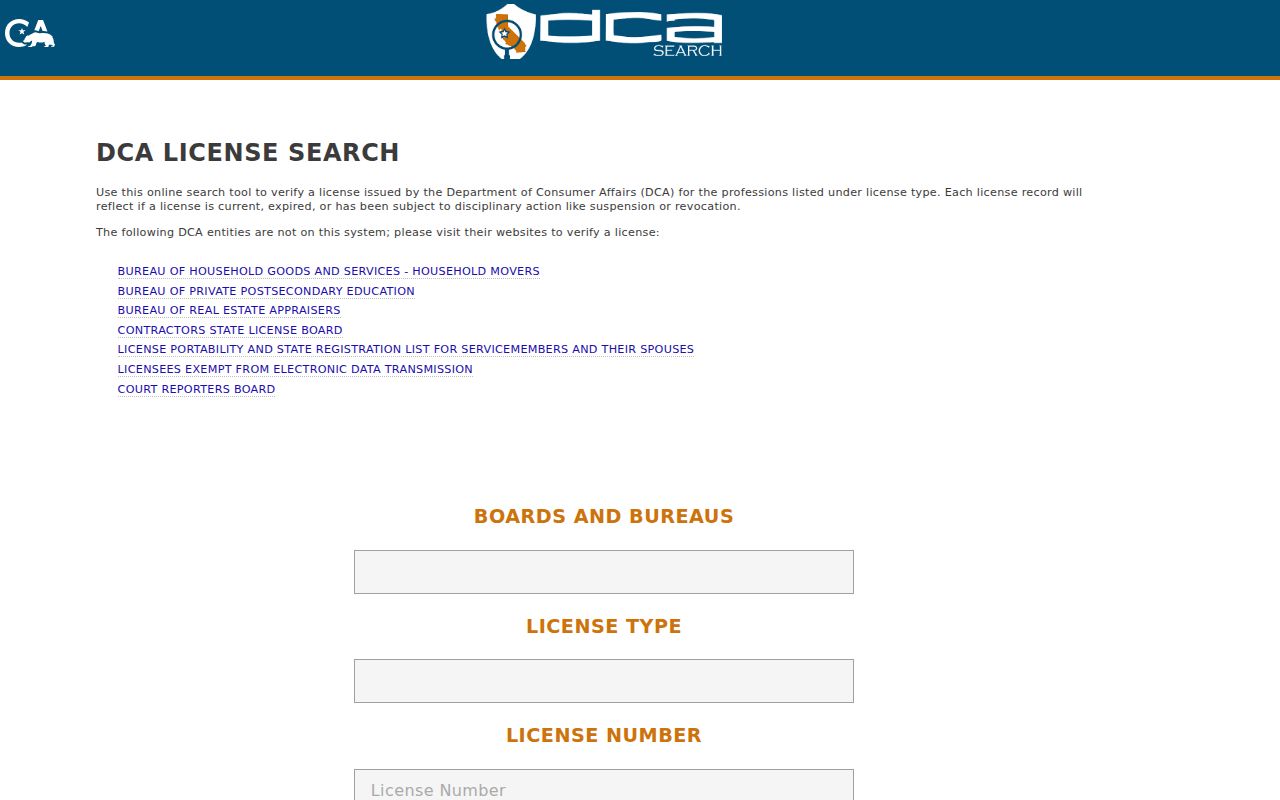
For licensed professionals, the California Department of Consumer Affairs license search provides the board and license route, letting you confirm standing through the state agency that holds the record.
Compare official records with a generic commercial people-finder category carefully: public indexes have named custodians and stated limits, while paid compilations may merge names, lag behind changes, or omit the reason a record is present.
| Source type | Strongest clue | What it cannot prove alone |
|---|---|---|
| Official county or state index | Named field, date, status, or filing | Complete household or current occupancy |
| Historical collection | Past name, address, event, or affiliation | Present-day identity without a second anchor |
| Commercial compilation | Possible lead across mixed sources | Custodian-level proof or a clean identity match |
Solano County Residents Directory Privacy
Privacy law shapes any Solano County residents directory. The Safe at Home program gives eligible survivors and other qualifying participants a substitute address. It also provides confidential mail forwarding under Government Code §§6205-6211. Voter rolls guard signatures, identity numbers, and similar sensitive fields. Court files, assessor parcel data, recorder deeds, and DMV or utility records each carry their own access rules. So an address missing from a resident lookup may reflect deliberate protection. It may not be a gap in the records.
Consumers hold real leverage too. The California Consumer Privacy Act and the California Privacy Rights Act, Civil Code §1798.100 et seq., grant rights to know, delete, correct, and opt out of sale or sharing. There are exceptions. The state's Delete Request and Opt-Out Platform launched January 1, 2026. Registered brokers must retrieve requests at least every 45 days beginning August 1, 2026. The state reports the system reaches more than 600 of them. Go through the official process. A paid removal promise adds nothing.
Lawful use. Solano County public records support family history, civic research, reconnecting, and personal safety awareness. Do not use a name or address trail to stalk, harass, intimidate, or harm anyone.
Historical Solano County Residents Directory
Historical resident directories for Solano County sit scattered across cities and repositories. The Solano County Genealogical Society library catalogs several early volumes. Its listings span an 1871 Solano and Napa Counties volume, an 1874 Solano section, McKenney's District Directory for 1878-79, and McKenney's Eight County Directory for 1884-85. The holdings go well beyond directories. They include undated Vallejo, Fairfield-Suisun, and telephone-book runs, Great Register material, a naturalization index, newspaper indexes covering all seven cities, and a compiled death database.
Solano County Library adds more. It offers Ancestry Library Edition at a branch, Digital Microfilm on public branch computers, and a searchable Vacaville Reporter archive spanning 1883-1946. The library serves six cities. Benicia runs its own system while sharing the catalog and digital resources. A single directory entry can hold rich detail. It may list a name, spouse, occupation, employer, home marker, or street address. A criss-cross section works in reverse. It turns an address into a listed household. Year-by-year runs are ultimately a catalog question, so absence from one volume proves little.
For collections, abbreviations, and the household-by-household method, turn to the Solano County city directory collections page.
Solano County Records After 1850
Solano County was born on February 18, 1850, one of California's original 27 counties. That founding date shapes any records trail. A deed, naturalization, probate file, map, or newspaper from the early years may sit in a different office. You might not expect it there. The Historical Records Commission holds thousands of organized and indexed records. The collection includes naturalizations, probate material, and Sanborn maps. Volunteers spent roughly three decades building this finding aid after the commission formed in 1987.
This is no walk-in counter. A 2015 lease loss pushed material into storage at Point Richmond. Research requests should go to historicalrecords@solanocounty.com with a precise name, date, and series question. The California State Archives serves as a fallback for state-government papers and selected county material. When a chain predates county creation, move from county deed books to rancho, state, federal land-patent, church, cemetery, and newspaper sources. Do not blame the index.
The lesson for old Solano County residents directory work is practical. A cataloged box or microfilm reel may matter more than a modern search form. Treat this local history as both an interest clue and an access warning.
A Solano County CPRA Records Request
Some records exist but offer no public search screen. In that case, send a focused California Public Records Act request to the likely custodian. Name the agency, the record series, the date range, and a parcel, address, case number, or person. State whether you prefer inspection or copies. The agency usually decides whether disclosable records exist within 10 calendar days, and unusual circumstances can extend that determination by up to 14 more days.
Inspection under CPRA is normally free. Copy charges stay limited to direct duplication costs unless another statute sets a fee. The law does not oblige a clerk to build a new resident report, list every person sharing a street, or assemble unrelated databases just to answer a question. Ask instead for an existing series, such as a permit history, a closed code case notice, an index book, a map sheet, or a filing.
The strongest request follows the trail step by step. Pull the APN and situs address from the assessor or map. Get the indexed party from the Recorder. Take the case or filing number from the court or Clerk, then give a date span the custodian can actually search. That discipline keeps a Solano County residents directory search productive, without stretching a public-records law into a demand for private household data.